WhatsApp CRM for Real Estate: A Company Brain Case Study
How a 45-day WhatsApp CRM for a real estate agency became the core of a company brain for five businesses, and what losing the next project taught us.
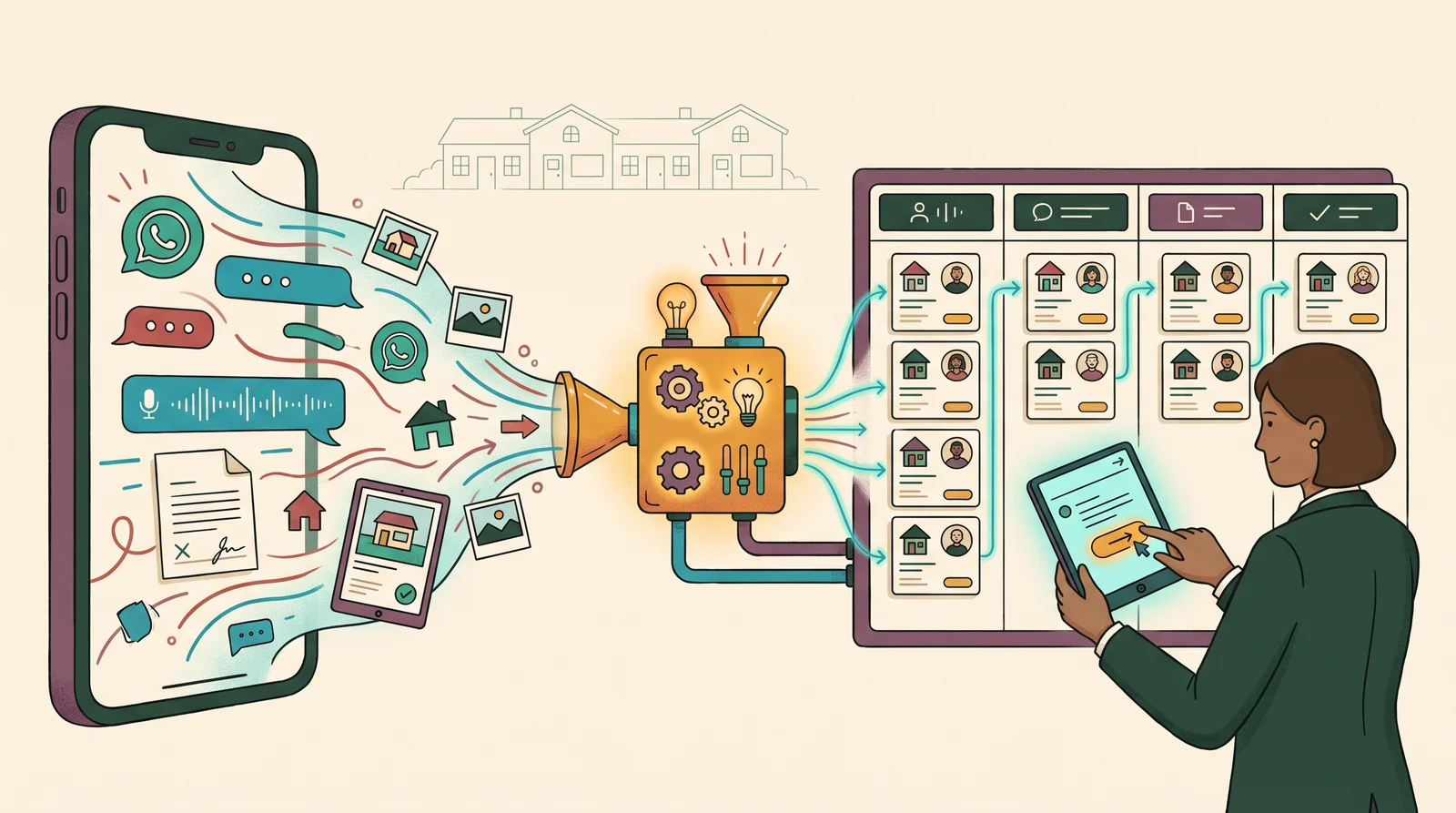
Picture a typical morning at a busy estate agency. A buyer sends a voice note about a three-bedroom near the school.
Another sends a photo of a signed offer and asks whether the price on last month’s listing still holds. A colleague forwards a screenshot from a group chat with the comment “is this ours?”
Every one of those messages is a potential sale. Most of them live in WhatsApp, spread across personal phones, group chats and voice notes nobody has time to replay.
That was the kind of chaos Thrive Real Estate faced when we started working with its owner, Rachel Smith. In 45 days we turned its buyer chats into a working sales pipeline. Then we lost the next project. What follows is how that small WhatsApp CRM build became the first piece of a company brain for a group of five businesses.
Key takeaways
- Luma, a WhatsApp CRM MVP for Thrive Real Estate, was delivered in 45 days. During the MVP it handled at least 100 buyer conversations, plus the documents that came with them, and turned 50 voice notes into searchable text.
- New leads appeared in the pipeline as soon as the first message arrived, and manual logging stopped.
- The assistant prepared and a person decided. Nothing was sent on the team’s behalf.
- We lost the follow-on project to the firm building Thrive’s new properties, which came with its own AI software. The WhatsApp pipeline is now the core of Harbour, a company brain we are building for five companies.
- Start with the one workflow that costs you most when it slips, and prove it in weeks.
The problem: buyer conversations with no shared memory
The team was not short of effort. It was responsive and busy. The problem was that the business had no shared memory. The history of every buyer lived in someone’s chat list, and the next step lived in someone’s head.
That is common, not careless. WhatsApp had more than 3 billion monthly active users as of April 2025 (Meta, Q1 2025 earnings call). Meta says people now have more than one billion active threads with businesses every day across WhatsApp, Messenger and Instagram (Meta, June 2026). Customers already chose the channel. Many small businesses have nothing behind it that can act on those conversations.
For a real estate agency, the cost is easy to picture. A buyer who mentioned a budget in March, sent a document in April and went quiet in May looks like three unrelated chats. Nobody sees the pattern until the buyer has signed somewhere else.
Act one: a 45-day WhatsApp CRM MVP for real estate
Start with one workflow, not a full CRM rollout
It would have been easy to propose a full CRM rollout. New software, a migration plan, training sessions, a long timeline.
We did the opposite.
Our work starts with one costly, repeated workflow. At Thrive, that workflow was obvious: buyer conversations were arriving in WhatsApp and leaving no trace in any system that could act on them.
So the project had one job. Turn those chats into a sales pipeline, and prove it in about six weeks.
What Luma did
We called it Luma. It was the first build on our own CRM foundation and our own WhatsApp connector. The scope was deliberately narrow.
- Conversations became leads. A buyer chat became a lead record with the conversation attached as context, not copied into a note. (Why that matters is the subject of Your Second Brain Is Not a Pipeline.)
- Voice notes became text. Transcripts made spoken messages searchable.
- Documents became readable. Luma could read the contracts, invoices and other files buyers sent, and keep them with the right lead.
- The day started with a brief. Each morning, Luma summarised who needed a reply, who had gone quiet and what had changed.
- History became a question you could ask. “What did this buyer say about budget in March?” got an answer with the source attached.
One rule ran through all of it: the assistant prepares, and a person decides. Reply drafts waited for human review. Nothing was sent on the team’s behalf.
That rule was not caution for its own sake. Buyers trust the agent, not the software. A system that sends the wrong message at the wrong time costs more than it saves.
The results: what the WhatsApp CRM changed in 45 days
We delivered Luma in 45 days. The figures below come from our project records for the MVP period. We do not have measured “before” numbers, so the Before column describes how the work was done, not a count.
| Measure | Before Luma | With Luma |
|---|---|---|
| Where buyer history lived | Personal phones and group chats | A lead record with the conversation attached |
| When a new lead reached the pipeline | When someone copied it in, if they remembered | As soon as the first message arrived |
| Manual logging | Copying chats and retyping phone numbers | Stopped |
| Documents from buyers | Buried in chat threads | Read by Luma and filed with the right lead |
| Voice notes | Replayed, if anyone had time | 50 voice notes turned into searchable text |
| Volume handled | No shared record | At least 100 buyer conversations, plus documents |
The biggest change was speed. Nobody had to copy a chat into a spreadsheet, retype a phone number or remember to log it later. That manual work simply stopped.
Luma worked in one language. Since then we have added 15 more to the platform underneath it, because the next clients needed them.
Rachel’s verdict was about how it was built, not just what it did:
This is real engineering, not a quick AI-generated patchwork. The tech stack is sensible, the code is well separated, and the project includes migrations and a proper test suite. That matters because AI-assisted changes become much safer when you can immediately verify that nothing broke.
Rachel Smith, Owner, Thrive Real Estate
What happened after the MVP: we lost the next project
The MVP did its job. It proved that AI could organise the WhatsApp chaos without asking anyone to change how they talk to buyers.
The longer project went elsewhere.
Rachel was also hiring a firm to build the agency’s new properties, and that firm came with its own AI software. Bundling made sense. One supplier, one contract, one system tied to the developments themselves.
We would rather tell you that than pretend every MVP turns into a long engagement.
But a well-run MVP is not wasted when the contract goes elsewhere. The client keeps what they learned about their own process. We keep what we learned about building it. And the parts that worked do not disappear.
The WhatsApp pipeline was the part that worked best. So we carried it forward.
Act two: Harbour, a company brain for five businesses
The problem at a larger scale
Our next client had the same problem at a larger scale.
One owner. Five companies. Several teams in each. Years of work spread across WhatsApp groups, inboxes, call notes and an off-the-shelf ERP that no longer fit how the group actually ran.
They did not need another dashboard. They needed one place where the whole group could remember, and where every conversation could become the right next action.
We call that system Harbour. It is the place where everything will land, and we are building it now.
What Harbour is
It is not a folder of notes with search on top. It is a company brain: modelled on the way Obsidian links ideas, but designed to run on the client’s own server, with every note, chat, task and file linked back to a company or contact. If the term is new to you, our guide to what a company brain is explains the idea from the ground up.
Harbour will bring the WhatsApp pipeline from Luma into a full company brain for the group. And a company brain for five companies has to answer questions a personal second brain never faces.
Who is allowed to see what? Which conversations belong in the system at all? What is the assistant allowed to do?
Three design rules
Each company stays separate. Every company gets its own space. The design stops one company from seeing another’s data by accident, and the owner will see across them only through access that is granted and recorded.
Teams share contacts, not conversations. Sales and operations will both see the same client. They will not automatically see each other’s messages, tasks or notes. Handing a conversation over will be a deliberate, recorded step.
Nothing comes in by default. Each company will connect its own dedicated WhatsApp number, and a person will choose which groups the system may keep. Until then, no message content will be stored. Leaving something out is a decision, not an oversight.
How the rules are enforced
The rules are not settings in a menu. Harbour is designed to enforce them in the database itself, so a search, a summary or the assistant cannot reach what the person asking is not allowed to see.
WhatsApp is only one way in. The same design is meant to file a company’s chats into Google Drive, with a folder per contact, media sorted alongside, and a spreadsheet of every message.
The assistant keeps the rule it had in Luma. It drafts and cites, and when the evidence is missing, it says so instead of guessing.
Why Harbour did not start from zero
Many custom software projects start from a blank page, and that is where much of the cost and delay comes from.
Luma was built on a foundation we reuse across client projects: identity, permissions, contacts, tasks, linked knowledge and a bounded assistant. That foundation is what made a 45-day MVP possible.
It is also why Harbour did not start from zero. The WhatsApp connector, the pipeline and the “prepare, don’t send” assistant were already built and tested on a real business. What Harbour adds is the structure a group of companies needs around them.
The client does not have to learn the foundation. They see their own system, shaped around how their teams already work.
What we learned from both builds
Prove one workflow before you plan a platform. Luma did one job. That narrow scope is why it shipped in 45 days and why its results were easy to see.
Keep a person on the send button. The assistant drafts and a person decides. It is the rule we carried, unchanged, into Harbour.
Build so the work survives the contract. We lost the follow-on project, but the pipeline was well separated and tested, so it moved into the next build intact. Rachel’s quote points to why.
A pipeline is not a company brain, but it is a good first room. A WhatsApp CRM answers “who needs a reply?” A company brain answers “what do we know about this client, and who may see it?” For how a company brain also differs from a knowledge base or a personal second brain, see business knowledge base vs second brain.
WhatsApp CRM questions we get asked
How long does a first WhatsApp CRM build take?
Luma took 45 days from start to delivery. It was built on a reusable foundation, and the scope was one workflow, not a whole platform.
What should a WhatsApp CRM for real estate capture?
Text messages, voice notes and documents, all attached to the right buyer. In Luma, voice notes were turned into text, contracts and invoices were read and filed with the lead, and each chat sat on the lead record as context rather than being copied into a note.
Can a WhatsApp CRM reply to buyers automatically?
It can, and many WhatsApp AI agents are sold on exactly that. Luma did not. It drafted replies, and a person reviewed and sent every one, because buyers trust the agent, not the software.
What is the difference between a WhatsApp CRM and a company brain?
A WhatsApp CRM turns chats into leads and next steps for one workflow. A company brain is the shared memory of the whole business, with permissions that decide who sees what. Luma was the first. Harbour is the second.
Before you build a company brain: the one-workflow test
You do not need a full system to find out whether this would help.
Pick the one workflow that costs you the most when it slips. For many founders, it is the same one Thrive had: conversations that should become sales but disappear into a chat list.
Ask:
If this one workflow organised itself, what would it prove about the rest of the business?
If the answer is “a lot”, start there. Prove it in weeks, not quarters. Then decide what comes next with real evidence in front of you.
Sometimes the next step is with us. Sometimes it is not. Either way, you will know what your business needs.
A pipeline answers who needs a reply. A company brain answers what we know and who may see it.
Map your workflow
If conversations that should become sales keep disappearing into a chat list, start with that workflow. We can map how your team works today, what should be captured, and whether a first build would help.
Book a Map your workflow call.
Sources and further reading
- Meta Q1 2025 earnings call transcript: WhatsApp monthly active users.
- Meta Newsroom, June 2026: daily active threads between people and businesses across Meta’s apps.
- Luma results: ZenRocket AI project records, 2026. Testimonial from Rachel Smith, Owner, Thrive Real Estate, as published on the ZenRocket AI homepage.
- What is a company brain? A guide for small businesses: the five parts of a company brain, and how small teams start.
- Your Second Brain Is Not a Pipeline: why a conversation should become a lead, a task or a decision instead of another note.
- Why your wiki doesn’t fix knowledge management: why writing more pages rarely solves the problem.
- Nick Saraev, “How to Build a Personal Knowledge Base with Claude Code”: a walkthrough of a personal second brain. Harbour is what that idea looks like when a group of companies needs it.
- Vannevar Bush, “As We May Think” (The Atlantic, 1945): the original vision of a machine that remembers for us.
What is your team carrying that a system should?
Map one workflow that keeps getting missed, rebuilt, or stuck in someone’s head.
Map your workflow